
What Is Alazani Valley Wine?
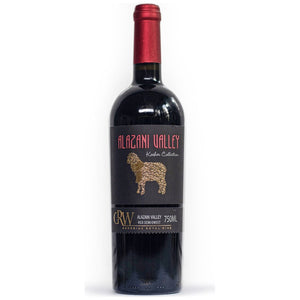

Alazani Valley is a semi-sweet Georgian red, and the name on the label is a river valley, not an appellation. That one fact clears up most of the confusion around it. Kindzmarauli and Mukuzani are protected names tied to a specific patch of ground. Alazani Valley is the broad name for a style that comes out of the same part of the country, which is why you will see it from a dozen different producers at a friendly price.
Ours is GRW Alazani Valley mevushal under OU and kosher for Passover. If you want the short version: it is the soft, jammy, gently sweet red that Georgians hand to a guest, and it is the easiest bottle on the Georgian shelf for a table that does not drink dry.
Where the name comes from
The Alazani is the river that runs down the length of Kakheti, the valley in eastern Georgia that makes most of the country's wine. The floor of that valley is warm, and warm means riper grapes with more sugar in them than the hillsides further up.
So the valley got its name on a bottle. Any winery working with fruit from that stretch can call the wine Alazani Valley, and most of them make one, because it is the style the country drinks at home.
Why it is sweet
Georgian semi-sweet reds are not sweetened after the fact. The grapes come in ripe, fermentation gets stopped while some of the natural grape sugar is still there, and what is left in the glass is fruit sugar rather than anything added later. The alcohol lands low as a result. Ours is 11.5%, which is a point and a half under a standard dry red.
That is the whole reason these wines work at a long table. A bottle at 11.5% that tastes like black cherry preserves is a wine people actually finish, and it is the one that gets poured for somebody who says they do not like red wine.
The part nobody mentions: there is a white grape in it
This is what separates Alazani Valley from the famous names. Kindzmarauli has to be Saperavi and nothing else. Alazani Valley is usually a blend, and the partner is Rkatsiteli, Georgia's workhorse white grape. Ours is a Saperavi and Rkatsiteli blend.
Blending a white grape into a red sounds strange if you learned wine in France, but it is ordinary in Georgia, and it does something useful here. Saperavi is one of the few grapes in the world with red flesh as well as red skin, so it brings plenty of color and grip on its own. The Rkatsiteli lightens the body and keeps the sweetness from turning heavy. You end up with a red that is soft and round rather than dense.
Alazani Valley, Kindzmarauli, Mukuzani: sorted out
- Alazani Valley, semi-sweet, a style from the valley floor, usually a blend. GRW Alazani Valley. The easy one.
- Kindzmarauli, semi-sweet, a protected zone on the left bank of the Alazani near Kvareli, pure Saperavi. GRW Kindzmarauli. Darker, deeper, more structured than Alazani Valley at the same money.
- Mukuzani, dry, a protected zone, pure Saperavi with real oak age. GRW Mukuzani. The one to pour for a dry drinker.
- Khvanchkara, semi-sweet, from Racha in the mountains rather than Kakheti, different grapes entirely. GRW Khvanchkara. The special-occasion sweet red.
There is a fifth name worth knowing. GRW Pirosmani is semi-dry rather than semi-sweet, so it sits exactly between Alazani Valley and Mukuzani. If Alazani Valley reads a touch sweet for you and Mukuzani reads a touch severe, Pirosmani is the bottle.
We walked through the whole country in the Georgian wine guide, and the Kindzmarauli page goes deeper on the protected-name side of this.
What ours tastes like
Black cherry preserves, blueberry and sweet plum. Medium-bodied, gently sweet, soft tannins, a little berry compote on the close. It is round rather than syrupy, and that is the test a good one has to pass. Serve it cool, around 60 degrees, which takes the edge off the sugar and tightens the fruit.
It is mevushal, which matters more than it sounds. Mevushal is what lets a wine get poured by anyone at a simcha or a kiddush without a question, and it is why this bottle turns up by the case at vorts and sheva brachos. We explain the term in mevushal vs non-mevushal.
What to eat with it
Sweet kugel. Cholent on Shabbos day. Brisket cooked with prunes or apricots, where the wine and the meat are reaching for the same flavor. Honey-glazed chicken. Anything at a kiddush table that is already a little sweet, because a dry red fights that food and this one does not.
It is also the bottle for dark chocolate at the end of a meal, which is a pairing most reds lose badly.
Where to browse
The full Georgian shelf sits at kosher Georgian wine, and if sweetness is the thing you are shopping for rather than the country, start at semi-sweet or read the best semi-sweet red wine. For the dry white end of Georgia, GRW Tsinandali is the classic.
Free shipping on orders $150+ in the lower 48.