
What Is Mukuzani Wine? Georgia's Dry Saperavi Appellation
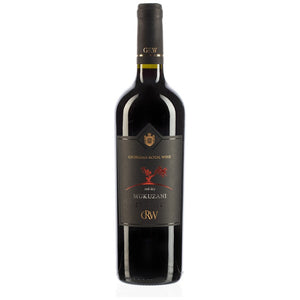

Mukuzani is a place, not a grape. It is a small growing zone in Kakheti, the valley in eastern Georgia that makes most of the country's wine, and a bottle may only call itself Mukuzani if the fruit comes from there, the grape is Saperavi, and the wine has spent at least three years aging, part of it in oak.
That last rule is the one that matters. Mukuzani is the dry, oak-aged, grown-up end of Georgian red, and it is the appellation that put dry Georgian wine in front of the rest of the world.
We carry two. Here is what the name means, how it differs from the Georgian wines next to it, and which of the two you want.
Mukuzani vs Saperavi: the question people actually ask
They are not alternatives. Saperavi is the grape. Mukuzani is the place and the rule.
Saperavi grows all over Georgia and gets made into everything: dry, semi-sweet, young, oaked, unoaked. It is a teinturier grape, meaning the flesh is red as well as the skin, which is why Georgian reds pour almost black. Our guide to what Saperavi is covers the grape on its own.
A wine labeled Mukuzani is Saperavi that passed a narrower test: right zone, dry, and aged. So every Mukuzani is a Saperavi, and most Saperavi is not Mukuzani. If you have had a Saperavi you liked and wanted something with more structure and less sweetness, Mukuzani is the step up and it is the same grape underneath.
Where it sits among the Georgian names
Georgian labels name zones, and three of them come up over and over. They are easy to tell apart once you know what each one commits to:
- Mukuzani. Dry. Saperavi. Oak-aged, minimum three years. The serious one.
- Kindzmarauli. Naturally semi-sweet Saperavi from the Kvareli zone. Same grape, opposite style, and the one most Americans meet first.
- Alazani Valley. A valley name rather than a protected zone, usually a softer semi-sweet blend. Looser rules than either of the above.
So Mukuzani and Kindzmarauli are the dry and sweet poles of the same grape. If somebody handed you a Georgian wine and it was sweet, it was almost certainly not a Mukuzani. Our Georgian wine guide runs through the rest of the map.
What it tastes like
Full-bodied and dry, with firm tannins that most wines at this price do not have. Blackberry and black cherry up front, a cocoa note behind it, dried herbs and a savory edge, and a long warm finish with an earthy grip at the end.
The usual shorthand is Georgia's answer to Bordeaux, and for once that comparison is fair: the oak, the tannin and the dry structure put it in the same part of the table. It wants food. Cholent, brisket, dry-aged steak, roast lamb, and if you are making khinkali or khachapuri it is the obvious bottle.
The two we carry
GRW Mukuzani Dry Red
Georgian Royal Wine's Mukuzani is the straightforward one. 13.5%, dry, oak-aged, OU and Kosher for Passover, not mevushal. Ripe blackberry and black cherry with soft cocoa over a light savory edge, full-bodied and structured on firm ripe tannins, a long warm finish.
Twenty dollars for an oak-aged appellation red with three years of required aging behind it is the reason this appellation has a following. Buy this one if nobody at the table needs mevushal.
Shimon & Co Mukuzani Dry Red Mevushal
The Shimon & Co bottling is the same zone, the same grape and the same dry style, and it is mevushal. 13.5%. Ripe blackberry and dark cherry with a cocoa lift and a dried-herb note, full-bodied, gentle spice, firm ripe tannins, warm long finish.
A mevushal dry Georgian Saperavi is a genuinely small category, which is most of the reason this bottle exists. It is the one for a simcha, a sheva brachos, or any table where the wine is being poured by someone other than the host. Note it is not listed as Kosher for Passover, so if that matters, the GRW is your bottle.
Which one to buy
- Shabbos at home, nobody pouring but family: GRW. Cheaper, and Kosher for Passover.
- A simcha, a caterer, a crowd: Shimon & Co for the mevushal.
- Pesach: GRW. It is the one that carries the certification.
- Buying for somebody who drinks Bordeaux or cabernet: either. This is the Georgian bottle that makes sense to them.
Serve it a little below room temperature, and open it twenty minutes ahead if you can. The tannins are firm enough that it improves in the glass.
The rest of the shelf is in Kosher Georgian Wine. Free shipping on orders $150+ in the lower 48.